Here’s what the data say about some common gun control ideas
Sep 15, 2025 | 7:00 am ET
Description
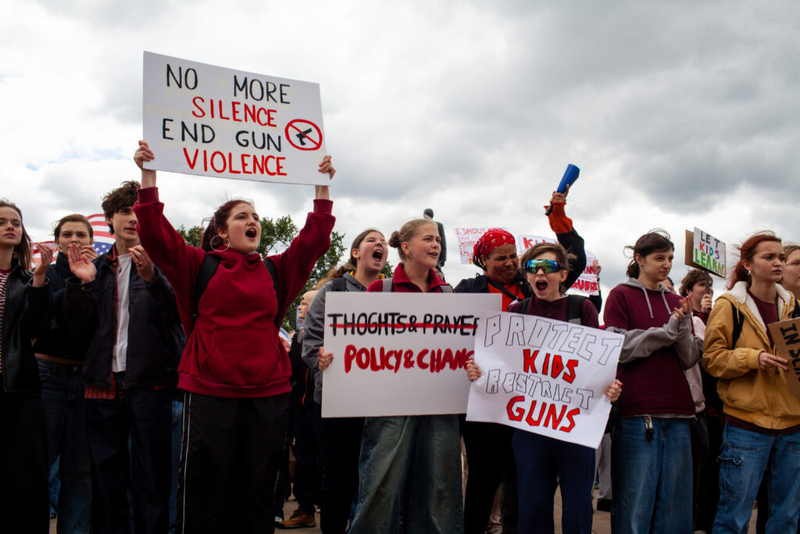
Students from St. Paul Conservatory for Performing Artists walk out to protest at the Minnesota State Capitol joining faith groups and gun control advocates in calling for a ban on assault weapons Friday, Sept. 5, 2025 following the mass shooting at Annunciation Church. (Photo by Nicole Neri/Minnesota Reformer)
The shooting at Annunciation Catholic Church in south Minneapolis last month has state lawmakers searching for ways to reduce gun violence, which is the leading cause of death for children in the United States.
Minnesota already has stricter-than-average gun laws, and it’s not clear whether any of the gun control measures up for discussion would have prevented a 23-year-old Minnesota resident from firing more than 100 rounds through the windows of Annunciation during the first Mass of the school year.
Even if Minnesota had banned semiautomatic military-style assault weapons, like the one used by the shooter, they’re available for purchase in every surrounding state. The assailant also brought a shotgun and handgun to the school.
The shooter would have passed background checks and didn’t trigger the state’s red flag law, which allows courts to order the confiscation of weapons from people who threaten their own life or others.
In other words, America’s permissive gun culture and laws — cultivated over many decades by the gun lobby and bipartisan but now mostly Republican politicians and their supporters — mean that even the most rigorous measures taken by individual states can only reduce deaths around the margins in a country that’s home to nearly 400 million firearms.
But those measures and others can still prevent future gun deaths, and are worth implementing, according to studies and gun violence prevention researchers.
In states with more permissive gun laws and higher gun ownership rates, more people die in shootings — and the gap between states with permissive and restrictive gun laws is growing, according to one study.
Although mass shootings draw the most attention, only 1% of firearm deaths in the U.S. occur in mass shootings. Most are suicides, and some are accidental deaths. Others are isolated homicides, many of which are committed by intimate partners.
America’s penchant for owning guns is striking compared to other countries. For every 100 Americans, there are 120 civilian guns, according to Switzerland-based Small Arms Survey — far more than the second-highest, which is 62 guns per 100 people in the Falkland Islands.
“I am not going to allow anyone to try and make the case that the United States is unique in either mental health issues or other things,” Walz said on Sept. 2 while announcing plans to call a special legislative session on gun violence. “The thing that makes America unique in terms of shootings is we just have more guns and the wrong types of guns that are on the streets.”
Walz’s priority for the special session is banning firearms like the AR-15-style rifle used by the Annunciation shooter. A DFL-led Senate Working Group on Gun Violence Prevention will evaluate other special session proposals this week.
“My hope is that the special session will be focused on the future as well — on what could prevent the next shooting — because it’s not going to be exactly what happened (at Annunciation),” said Kelly Roskam, director of law and policy at the Center for Gun Violence Solutions at Johns Hopkins University.
Here’s what data and experts say about the effectiveness of various gun control policies:
Assault weapon and high-capacity magazine bans
What constitutes an “assault weapon” varies state-to-state, but definitions usually include semi-automatic firearms that accept a detachable magazine and include one or more “military-style” features, such as a folding or telescoping stock.
Semi-automatic firearms fire one bullet each time the trigger is pulled, and automatically reloads the next bullet as the trigger is released. Most popular handguns, like the Glock 22, are semi-automatic; so are AR-15s and AK-47s. (Automatic firearms, which fire continuously while the trigger is pulled, and devices that convert semi-automatic weapons to automatic are highly restricted by federal law.)
Minnesota law lists 17 firearm makes and models, and all those with similar specifications, as “semiautomatic military-style assault weapons.”
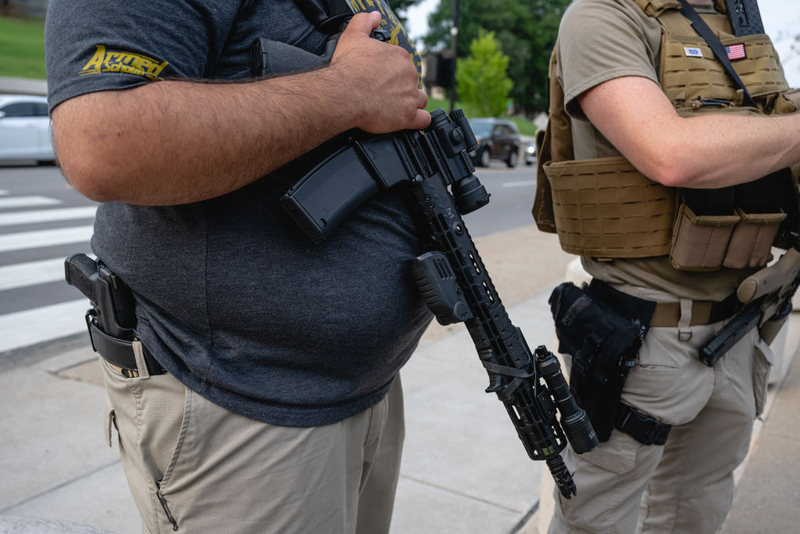
Since 2000, one-third of mass shootings involved assault weapons, according to data compiled by the Gun Violence Prevention Project at Hamline University. Most mass shootings — 52% — involved handguns.
A majority of the deadliest mass shootings, however — like those in Uvalde, Sutherland Springs, Orlando and Sandy Hook — involved assault rifles.
AR-15s and AK-47s are often selected by mass shooters for their ease of use and high velocity, which creates shockwaves that cause devastating damage to bodies even with smaller bullets than many handguns. A 2025 study found that the use of an assault weapon is associated with a slight increase in the number of injuries and deaths in mass shooting incidents.
The federal government banned the sale of assault weapons from 1994 to 2004, but people who purchased those guns before the ban took effect were allowed to keep them.
During the federal assault weapons ban, mass shooting incidents and deaths decreased. The trend reversed when the ban expired in 2004.
Ten states ban assault weapons. Fourteen states prohibit high-capacity magazines, usually defined as those with more than 10 rounds. (The standard magazine size for an AR-15 is 30 rounds, but some magazines hold up to 100 bullets.)
Some studies show that state-level high-capacity magazine bans reduce public mass shootings and fatalities.
There is less evidence that state-level assault weapons bans have the same effect, in part because laws vary widely from state-to-state, making comparisons difficult, said Roskam, the Johns Hopkins researcher.
Because high-capacity magazine bans and assault weapons bans often go hand-in-hand, researchers struggle to disentangle the two policies.
Regardless: “It is incredibly clear that assault weapons are used in and facilitate a lot of mass shootings. And despite the lack of clear evidence, because of some of the research limitations that I identified, we do feel that they would have a protective effect,” Roskam said.
A range of factors could limit the impact of a state-level ban: The grandfathering-in of existing weapons; the ease of transporting firearms across state lines; and the rush to purchase affected weapons before a ban takes effect.
Extreme risk protection orders, or “red flag” laws
If a person poses a significant threat of bodily harm to others or is at risk of suicide, family members or law enforcement officers can ask a judge to order the confiscation of that person’s firearms for up to one year.
This policy, called an “extreme risk protection order” or “red flag law” took effect in January 2024 after the DFL-controlled Legislature passed a law in 2023.
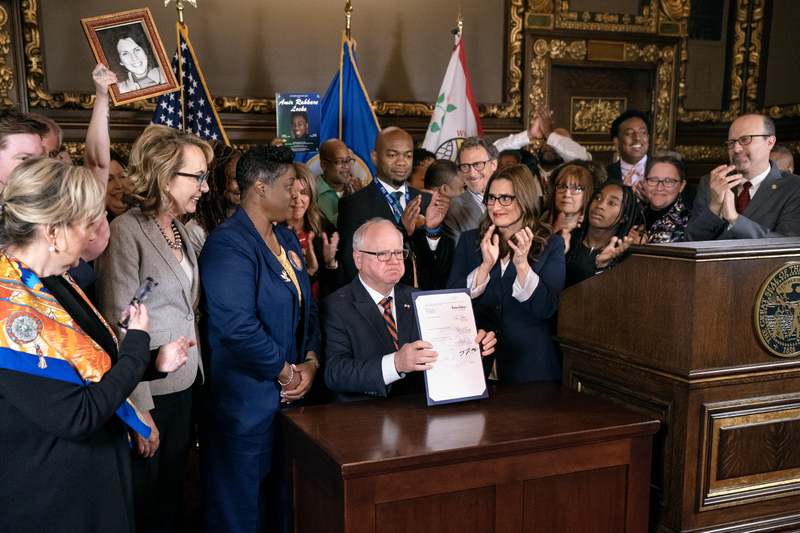
Extreme risk protection orders can reduce gun deaths, including suicides, homicides and mass shootings, according to a limited body of research. Indiana’s red flag law is associated with a a 7.5% reduction in firearm suicides, and gun suicides declined nearly 14% in Connecticut after a similar law passed there.
There’s also evidence that red flag laws prevent some mass shootings; For instance, out of 159 orders issued from 2016 to 2018 in California, 21 subjects displayed intent to commit a mass shooting. After their firearms were confiscated, none of those people committed suicide or homicide.
Red flag laws are relatively new, and the evidence to support their effectiveness is less robust than that of the federal assault weapons ban.
“It’s also very difficult to prove a negative — to prove the shootings that don’t happen,” said Jaclyn Schildkraut, executive director of the Regional Gun Violence Research Consortium at the Rockefeller Institute of Government.
The impact of extreme risk protection orders is dependent on the public’s knowledge of the law, and law enforcement agencies’ participation, Roskam said.
In Minnesota, more petitions for extreme risk protection orders were filed in the first seven months of 2025 than in all of 2024, signaling increased public participation and enforcement of the law, MinnPost reported.
Safe storage laws
In Minnesota, it’s illegal to negligently store a loaded firearm in a location where the person knows, or reasonably should know, that a child is likely to gain access, unless the owner takes “reasonable action” to prevent the child from accessing the gun.
The statute is known as a child-access prevention law, a type of safe storage law, and it’s one of the most effective ways to prevent suicides, accidental shootings and homicides by minors, according to several studies.
And while there’s not substantial evidence to prove that child-access prevention laws reduce mass shootings, one study found that two-thirds of school shooters obtained their firearms from family or friends.
The Minnesota House passed an even stricter safe storage bill in 2024, but it did not come to a vote in the Senate. That bill would have required gun owners to store their firearms unloaded and equipped with a locking device; or, loaded or unloaded, in a locked firearm storage unit or room.
Most research on safe storage policies focuses on the child access piece of the law. While safe storage laws are usually not proactively enforced, they provide a path for parents to be charged in the event that their child accesses a negligently-stored firearm and uses it in a crime.
“It’s not just about the passage of the law, or even the enforcement of the criminal penalties — It’s also about educating people about the benefits and the risks that they face from not doing it,” Roskam said.

School safety
Minnesota Republicans say they will approach a special session with a focus on school safety, rather than gun control.
Schildkraut’s team at the Regional Gun Violence Research Consortium is analyzing pre-attack communications and warning behaviors of mass shooters with the goal of increasing awareness and public reporting of potential threats.* (Federal funding for that project was canceled earlier this year because it does not align with the Trump administration’s priorities, Schildkraut said. The research is ongoing with other funding sources.)
“To undergo a behavioral threat assessment process, you need that person to be on somebody’s radar. And when you’re thinking about schools, the people whose radar…he or she is most likely to be on, is the other students,” Schildkraut said.
Teaching students about the warning signs and behaviors of students in crisis and creating anonymous tip lines can help schools and law enforcement agencies identify students who may pose a threat — before they commit a violent act against themselves or others.
“The firearm is the means, right? But the motivation and the method … why they’re doing this and what is underpinning all of that certainly doesn’t always revolve around that firearm,” Schildkraut said.
*Correction: A previous version of this article provided an inaccurate description of the ongoing research project.

Saint Paul, MN